
🌐
A practical guide to implementing production-ready machine learning models, covering deployment strategies, MLOps, monitoring, scalability, and best practices.
Emily Wong
ML Engineer
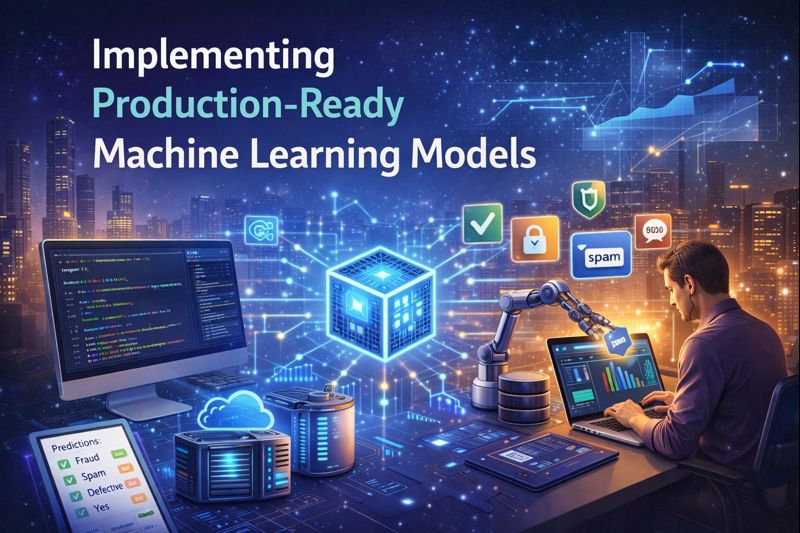
Building a machine learning model in a notebook is only the beginning. The real challenge lies in deploying, scaling, and maintaining that model in a production environment. Production-ready machine learning systems must be reliable, scalable, secure, and continuously monitored.
In this guide, we explore the complete lifecycle of implementing production-ready machine learning models — from development to deployment and ongoing maintenance.
A production-ready machine learning model is one that:
Production ML is not just about model accuracy — it’s about reliability, observability, and performance.
During this stage, data scientists train and evaluate models using frameworks like TensorFlow, PyTorch, or Scikit-learn. Performance metrics such as accuracy, precision, recall, and F1-score are analyzed.
Before deployment, models must undergo rigorous validation using unseen datasets to ensure they generalize well.
The trained model is serialized (e.g., .pkl, .onnx, .pt format) and wrapped inside an API using frameworks like Flask or FastAPI.
The model API is deployed to cloud platforms such as AWS, Azure, or Google Cloud using containers (Docker) or serverless architecture.
After deployment, models must be monitored for performance degradation, drift, and system errors.
Modern ML systems often follow MLOps principles to automate these workflows.
MLOps (Machine Learning Operations) combines DevOps practices with machine learning workflows to ensure smooth deployment and lifecycle management.
Key components of MLOps include:
MLOps ensures that ML systems remain scalable and maintainable over time.
When real-world input data changes over time, model accuracy can decline. Continuous monitoring is required.
Changes in user behavior or market trends can reduce prediction quality.
Real-time applications require low-latency predictions. Optimized infrastructure and caching help mitigate delays.
Handling high traffic requires load balancing and auto-scaling mechanisms.
ML systems must protect sensitive user data and comply with regulatory requirements.
Use CI/CD pipelines for model testing and deployment.
Maintain model versioning to roll back in case of failure.
Track prediction accuracy, latency, and error rates in real-time.
Deploy models using Docker containers for consistency across environments.
Set up automated retraining pipelines using updated data.
Batch Deployment: Processes large volumes of data periodically (e.g., daily reports).
Real-Time Deployment: Provides instant predictions via API calls (e.g., fraud detection).
Choosing the right deployment strategy depends on business requirements and latency expectations.
These tools help streamline deployment, monitoring, and scaling processes.
The future of ML deployment lies in fully automated pipelines, AI-driven monitoring systems, and serverless machine learning platforms. Organizations are increasingly investing in scalable AI infrastructure to maintain competitive advantages.
As machine learning adoption grows, production reliability will become even more critical than model accuracy.
Implementing production-ready machine learning models requires more than training a high-performing algorithm. It demands robust infrastructure, automation, monitoring, scalability, and strong MLOps practices.
Organizations that focus on operational excellence in machine learning will unlock the true value of AI in real-world applications.
Tags: