
🌐
Discover how AI is transforming customer service automation through chatbots, predictive analytics, personalization, and intelligent workflow optimization.
Sarah Chen
AI Product Manager
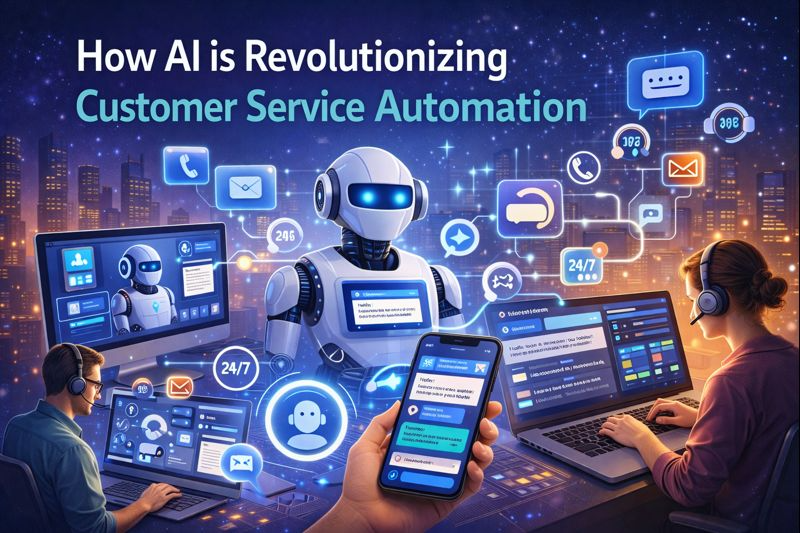
Customer expectations are higher than ever. Businesses must provide instant responses, personalized experiences, and 24/7 support. Traditional customer service models struggle to meet these demands efficiently. Artificial Intelligence (AI) is transforming customer service automation by making support faster, smarter, and more scalable.
From AI-powered chatbots to predictive analytics and sentiment analysis, modern AI systems are reshaping how companies interact with customers.
Customer service has evolved from call centers and email-based support to omnichannel digital experiences. However, manual support systems are expensive and difficult to scale.
AI-driven automation addresses these challenges by reducing human workload while improving response quality and speed.
AI-powered chatbots can handle common queries instantly. They understand context, process natural language, and provide human-like responses. Modern chatbots are capable of resolving a significant percentage of support tickets without human intervention.
Unlike traditional support teams, AI systems operate around the clock. This ensures customers receive assistance anytime, regardless of time zones.
AI analyzes customer data, past interactions, and behavior patterns to deliver tailored responses and recommendations.
AI systems can predict potential issues before customers report them. For example, SaaS platforms can notify users about potential billing issues or system disruptions proactively.
Natural language processing (NLP) enables AI systems to detect customer emotions. Support tickets can be prioritized based on urgency or negative sentiment.
By automating repetitive queries, human agents can focus on complex or high-value customer interactions.
Modern customers interact across multiple platforms — websites, mobile apps, social media, and messaging apps. AI systems unify conversations across channels, ensuring seamless experiences.
This integration enhances consistency and maintains context throughout customer journeys.
Beyond chatbots, AI automates internal workflows such as:
This reduces manual effort and speeds up issue resolution.
AI systems require access to customer data. Businesses must ensure compliance with data protection regulations.
Integrating AI tools with existing CRM and support platforms can require technical expertise.
While automation improves efficiency, maintaining empathy and personalization remains crucial.
A balanced approach ensures automation enhances, rather than replaces, human interaction.
The future of customer service lies in intelligent automation combined with human empathy. Emerging technologies such as generative AI and multimodal AI systems will enable even more advanced support capabilities.
Businesses that adopt AI-driven customer service automation today will gain competitive advantages in efficiency, scalability, and customer loyalty.
AI is revolutionizing customer service automation by transforming how businesses interact with customers. From instant chat responses to predictive issue resolution, AI-driven systems improve efficiency while enhancing customer satisfaction.
Companies that strategically implement AI automation will build stronger relationships, reduce operational costs, and deliver superior customer experiences.
Tags: