
🌐
A practical guide to implementing generative AI in business applications, from content creation and automation to real-world deployment strategies.
Olivia Martinez
AI Research Lead
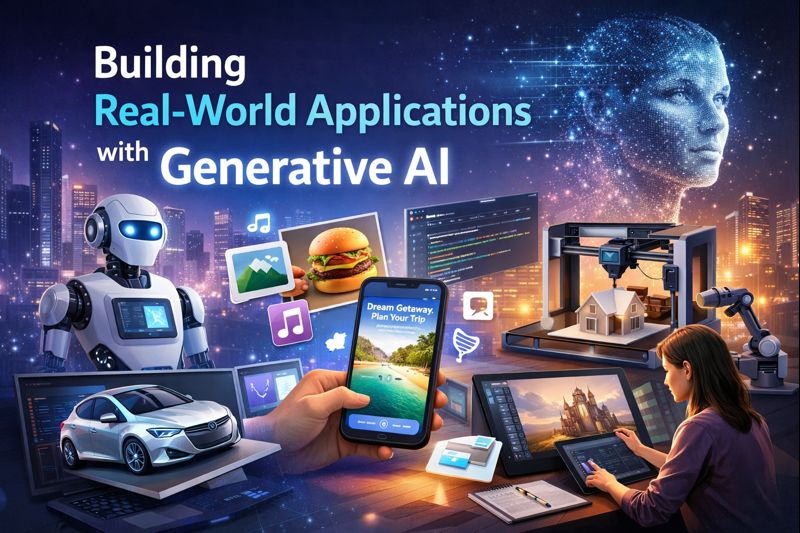
Generative AI is transforming how businesses build software, automate workflows, and deliver intelligent customer experiences. From content generation and design automation to coding assistants and AI-powered chatbots, generative AI is no longer experimental — it is production-ready.
In this guide, we will explore how to build real-world applications with generative AI, including practical use cases, architecture patterns, tools, and deployment strategies.
Generative AI refers to artificial intelligence systems capable of generating text, images, code, audio, and other content. These systems are typically powered by large language models (LLMs) such as GPT models and diffusion models.
Unlike traditional rule-based automation, generative AI learns patterns from large datasets and produces human-like outputs.
Companies that integrate generative AI strategically gain competitive advantages in efficiency, scalability, and personalization.
Businesses use generative AI to create blog posts, marketing copy, product descriptions, social media content, and SEO-optimized articles. AI tools help maintain consistency and reduce content production time significantly.
AI chatbots powered by large language models provide 24/7 support. These bots can understand context, generate human-like responses, and integrate with CRM systems.
Generative AI assists developers by writing boilerplate code, debugging errors, and generating API integrations. This speeds up development cycles and reduces human error.
Creative teams use AI for generating design mockups, marketing banners, UI prototypes, and product visuals.
Businesses automate document summarization, email drafting, report generation, and internal communication processes using generative AI.
Building a real-world AI application requires more than just calling an API. Here’s a typical architecture:
Security, rate limiting, and cost optimization are critical when scaling AI applications.
Craft clear, structured prompts to get high-quality outputs. Prompt engineering directly impacts model performance.
For business-critical applications, implement a human-in-the-loop system to verify AI outputs.
AI API calls can be expensive. Cache responses and use token-efficient prompts.
Never send sensitive data without encryption and compliance checks.
Track response time, token usage, error rates, and output accuracy.
Mitigating these challenges requires testing, monitoring, and proper guardrails.
Generative AI will continue evolving with multimodal models capable of handling text, images, video, and audio simultaneously. Businesses that adopt AI early and responsibly will dominate their industries.
The key is not just using generative AI — but integrating it strategically into scalable systems.
Building real-world applications with generative AI requires thoughtful architecture, strong prompt engineering, security considerations, and continuous optimization. When implemented correctly, generative AI becomes a powerful engine for innovation and business growth.
Organizations that embrace AI transformation today will lead tomorrow’s digital economy.
Tags: